


Scotland’s churches are a huge and vibrant part of our built, cultural, religious, artistic and architectural heritage – it’s hard to find a city street, town, village or hamlet without a church (or three) enlivening the streetscape.
The Church of Scotland (CoS) is taking a clear and robust stance: going forward, they are going to be focussing on their religious mission, not buildings, regardless of their religious history or indeed any other considerations of artistic merit. It, therefore, will go where the people are.
As a result, Scotland has a churches problem, and has done so for a long time. This is, of course, a problem across the whole of the UK, but it is especially acute in Scotland thanks to our long history of congregations splitting away from the main Kirk, moving up the road, and building themselves a new church building. There are too many church buildings and not enough people using them; so, a lot of these buildings are surplus to requirement with potential for reuse.
This is nothing new – it’s estimated that up to the 1990s, around one church a month was being put up for sale by the Church of Scotland [Ref 1]. There are plenty of great examples of historic churches finding a new second use outwith their religious use as a result – many of which AHF has helped with over the years.
Above Adventure in Kilmarnock – pictured above – is a great example of that. The Category B-listed former Grange Church was a Church of Scotland building that had been sold on to a private owner, then was later secured for a local community-led use. It’s now a vibrant and accessible indoor climbing centre, where you can get right up close to the stunning stained glass as you climb. The future of the building is secure, and it’s continuing to contribute positively to life in Kilmarnock – albeit in a very different way than before.
So, what’s different now? Only the scale and the speed of the church closures and proposed disposals. It’s estimated that around 400-700 churches will close across Scotland and be put up for sale, looking for a new use within the next few years [Ref 2]. And those are just the Church of Scotland ones – many of the other faith organisations that own older buildings are facing similar problems, and watching with interest as they consider similar solutions.
To put those closure numbers into context, since the AHF was set up to help communities secure new uses for historic buildings in the late 1970s, we’ve supported about 400 projects of all kinds of buildings across Scotland. So, from 400 projects in 40 years to date, now we face 400 churches in the next few years alone, and possibly as many as 700 closing by the end of the decade.
Of course, not all of the churches scheduled for disposal will be historic buildings, and not all local communities will want to take them on. But many will – and a lot of them are already stepping up to do so.
This is where the capacity and scaling problems come in. With so much happening so quickly, even with the CoS often allowing local groups a grace period of six months before putting a building on the open market, it is difficult and increasingly competitive to get funding to explore options for the future.
At the AHF, we offer a very useful grant to help with this sort of work – our Project Viability Grant [Ref 3] is a helpful tool to explore and develop business planning, seek outline costs, and to help show how the reuse of a historic building could help meet a community need. But even if we spent 100% of our annual budget for the next few years just on church studies and nothing else, we would still not be near to meeting that potential demand. Even if we could, there are not enough business planners and specialist surveyors to do the work for so many buildings all at once; and further up the chain of funding, there is not any additional capital money to help with so many regeneration projects in often difficult buildings to adapt, in such a short period of time. Ideally, it would be possible to slow the disposal process down, to allow for more strategic and considered decisions to be made about these buildings, right across Scotland.
In the meantime, voluntary sector organisations are collaborating to provide advice and support to community groups – the Your Church, Your Community guidance developed by the Heritage Trust Network, DTAS Community Ownership Service and Historic Churches Scotland is especially helpful [Ref 4].
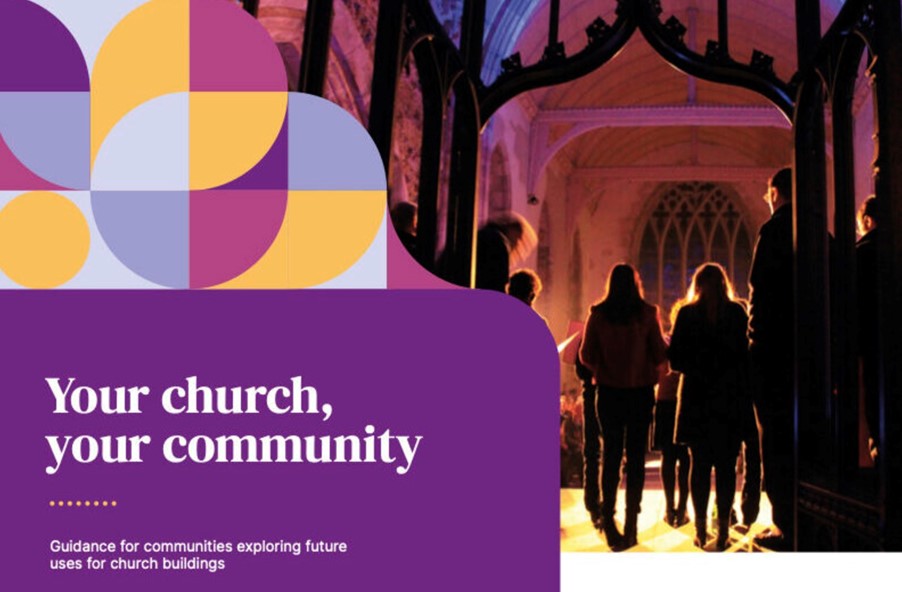
Image: Your Church, Your Community – guidance developed by Heritage Trust Network, DTAS Community Ownership Service and Historic Churches Scotland – see Ref. 4 for link.
At the AHF, we have piloted a more strategic approach by funding Fife Historic Buildings Trust (Fife HBT) to look at multiple historic church buildings across a single region, trying to broker buildings to community need with community capacity. Of the 400 churches at risk of being sold, 40-odd of them are in Fife. Of those, seven are Category A listed - Fife HBT began a desk study to look at all of them as a group. As the work progressed, two were later reprieved from closure. Three of the rest were then prioritised by Fife HBT to explore working more closely with the communities in those towns and villages. This has resulted in the identification of two projects where local groups have been able to consider potential new uses, as well as make initial economic assessments of how they might run and pay for themselves. This was all done within a six-month period. The economic assessments, in particular, will give groups a key tool to make their case to take on the buildings to the Church of Scotland and hopefully secure ownership.
This pilot study has shown the real value of involving a trusted third-party organisation like Fife HBT, which has experience in community-led regeneration, to be able to accelerate the process, signpost and open doors, and maximise the effects of existing community capacity and enthusiasm, by looking at a geographic grouping of churches and how they could work together in the future. It’s an approach we’d be keen to explore extending to other parts of Scotland if circumstances allow.
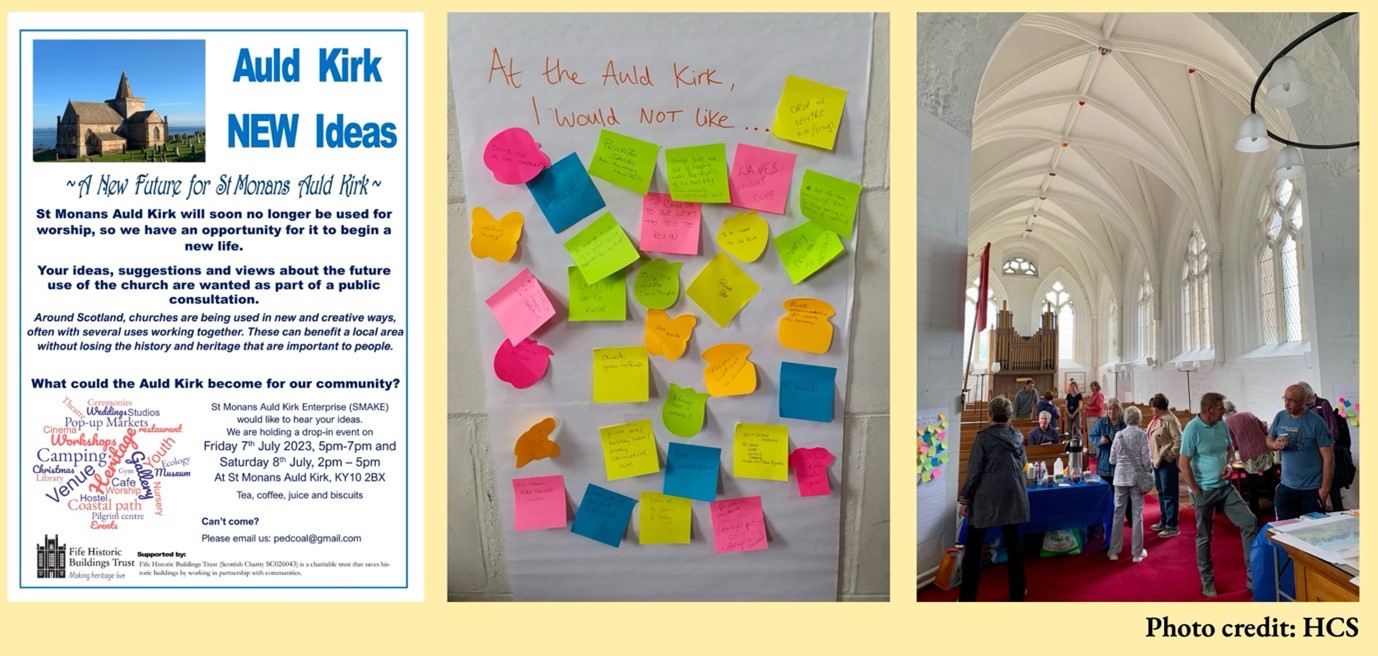
Image: St Monan’s Auld Kirk drop in community consultation sessions. Credit - HCS.
So, what can you do – how could you try and stand out from the crowd if the idea of taking on your local church sounds like something you want to consider? Here are my top tips to think about before embarking on this journey:
We’re always happy to speak to groups interested in taking on a historic building - a church or any sort of historic building! While we can’t fund everything, we’re keen to help and give advice and support where we can – that’s true not just in Scotland, but wherever in the UK there are communities looking to find sustainable new uses for their historic buildings.
Find out more or get in touch with us at www.ahfund.org.uk
Gordon Barr
AHF Development Manager, Scotland
References
[1 – SCT – Churches at Risk Publication
https://www.scottishcivictrust.org.uk/wp-content/uploads/2023/03/Churches-at-Risk-SCT.pdf]
[2 – SPAB Lecture: Scotland’s Churches: A History of Closure
https://www.spab.org.uk/whats-on/lectures/scotlands-churches-history-closure]
[3 – www.ahfund.org.uk/scotland ]
[4 – A Future For Your Church? Heritage Trust Network resources:
https://www.heritagetrustnetwork.org.uk/a-future-for-your-church/]