|
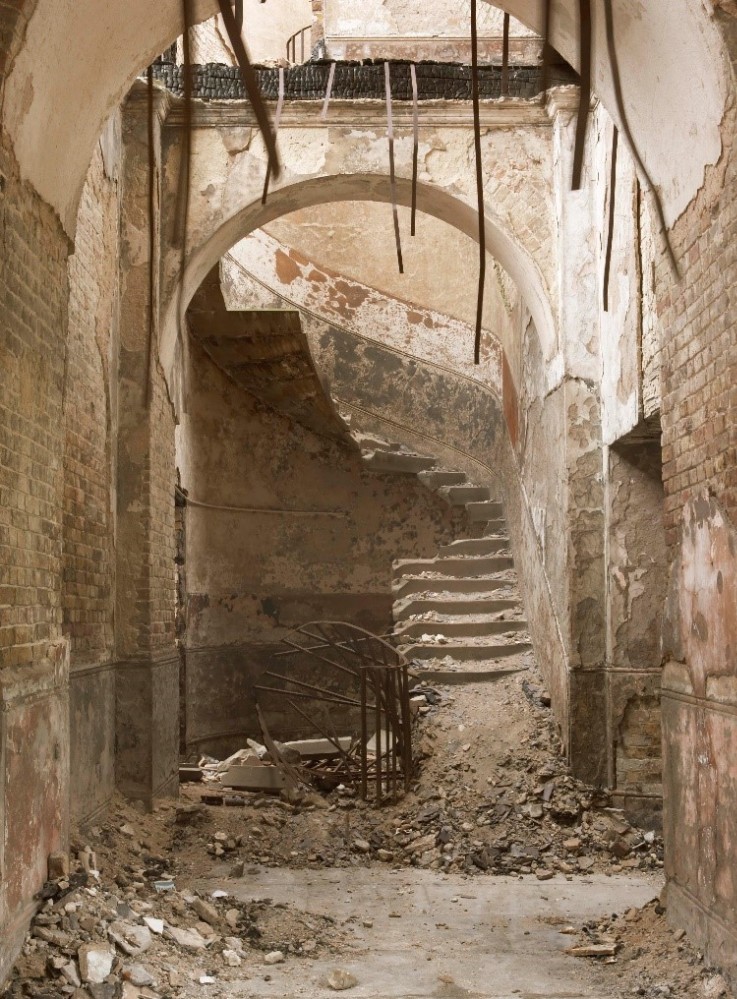
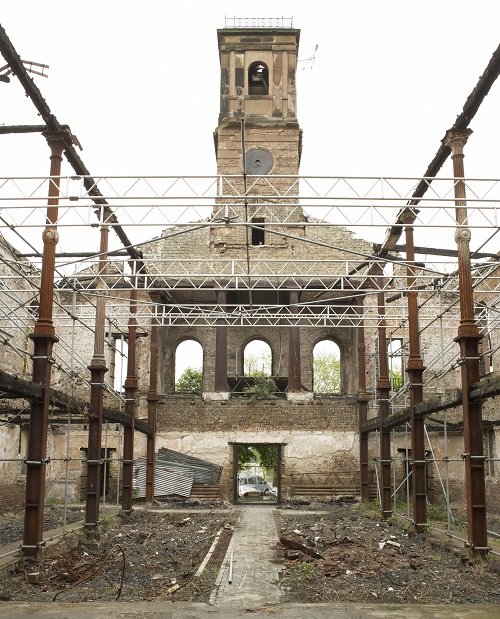
Sheerness was for centuries synonymous with its Royal Dockyard, from which tall ships sailed following construction or repair bearing names evocative of the golden age of British naval power – the HMS Daedalus, the Mermaid, the Fantome. Around these docks a community of carpenters, sailmakers and shipwrights grew. It was for this community, as well as the naval garrison established at Sheerness, that a new church was built. Completed in 1828, the grandly austere neo-classical Grade II* church was designed by George Ledwell Taylor, Surveyor of Buildings to the Navy. Conceived as an integral part of the overall Dockyard masterplan modelled at vast scale by John Rennie the Elder, the church’s massive Ionic portico and clock-tower announced the entrance to the Dockyard and held pride of place alongside the substantial new residences built for the Naval Officers. Rebuilt and embellished after a fire in 1881, the Church served the community until the 1980s, when it ceased use as a place of worship. A disastrous major fire at the end of the last century left the Church’s future in the balance, and while the surviving structure was added to Historic England's Heritage at Risk Register and the World Monuments Fund Watch List, for nearly two decades, Sheerness Dockyard Church has stood open to the elements. |
|
|
Now the Sheerness Dockyard Preservation Trust (SDPT) is working to restore and adapt the Church as a much-needed Enterprise Centre to support young people to develop and run their own businesses. Since the Navy vacated the Dockyard in 1960, dealing a massive blow to the local area, the Isle of Sheppey has been one of the most socially and economically disadvantaged areas of Kent. Eleven local neighbourhoods are within the 20% most deprived nationally, including several in Sheerness, and a lack of opportunities for young people is a pressing concern, with significant numbers not in education, employment or training. Operating through a partnership with the Kent Youth Support Trust, the Enterprise Centre will provide young people building businesses with premises, mentoring and training to get started and grow. Alongside this incubation hub will be a community cafe and event space, plus a changing display of Rennie's spectacular model, telling the story of the Royal Dockyard, a source of pride to local people. It will therefore provide a new destination in the town, encouraging footfall and the potential for tourism.
This project demonstrates that, with creative vision, heritage buildings can find a new purpose that meets critical needs within their communities in the current day. In this case, forging a successful partnership between organisations each with a distinct mission but a united concern for the locality, was the key to unlocking the future of this long-abandoned building.
The AHF supported the SDPT with a series of three Project Development Grants that helped them develop their plans and ultimately secure a £4.2 million award from the National Lottery Heritage Fund, plus over £3m from trusts and foundations, a huge fundraising achievement. The most recent AHF grant enabled the development of detailed tender documentation in preparation for starting on site later in 2020, taking into account the need for safe working in relation to Covid-19.
|
About the Sheerness Dockyard Preservation Trust The SDPT was formed in 2014 specifically to rescue the dockyard church, but with a remit also to preserve the dockyard's heritage. Action to save the naval residential quarters had been spearheaded by the Spitalfields Trust, a longstanding loan recipient of the AHF, which stepped in to take temporary ownership of the Church after it was compulsorily purchased by Swale District Council. This support by an experienced sector leader allowed time for the new bespoke Trust to be set up, building a Trustee board with strong links with the local community and experience of delivering heritage conservation projects.
AHF funding Project Development Grant, £12,800 (2015) Project Development Grant, £25,000 (2017) Project Development Grant, £12,200 (2018) Three PDGs from 2015-2018 totaling £50,000. These have all contributed to progressing the project to RIBA 4, primarily professional fees (architects, M&E services, structural engineers) These grants were made possible by funding from the Department for Digital, Culture, Media and Sport.
External funding National Lottery Heritage Fund £4,216,100 Management & Maintenance £253,920 The Allchurches Trust £102,000 The Garfield Weston Foundation £250,000 Kent Community Foundation £20,000 Colyer Fergusson Charitable Trust £400,000 The Foyle Foundation £165,000 Roger De Haan Charitable Trust £25,000 The Rothschild Foundation £10,000 The Lund Trust £330,000 Swire Charitable Trust £50,000 John Booth Charitable Trust £10,000 The Sackler Trust £210,000 Peter Darling Charitable Trust £12,500 Esme Fairbain Trust £15,000 Bernard Sunley Charitable Foundation £50,000 Fiona Sunley -The Young Lives Foundation £10,000 The Wolfson Foundation £50,000 The Pilgrim Trust £40,000 (£20,000 underwrite) Julia and Hans Rausing Trust £500,000 Linbury Trust £50,000 Naval Dockyard Society £1000 |
|
|
June 2021